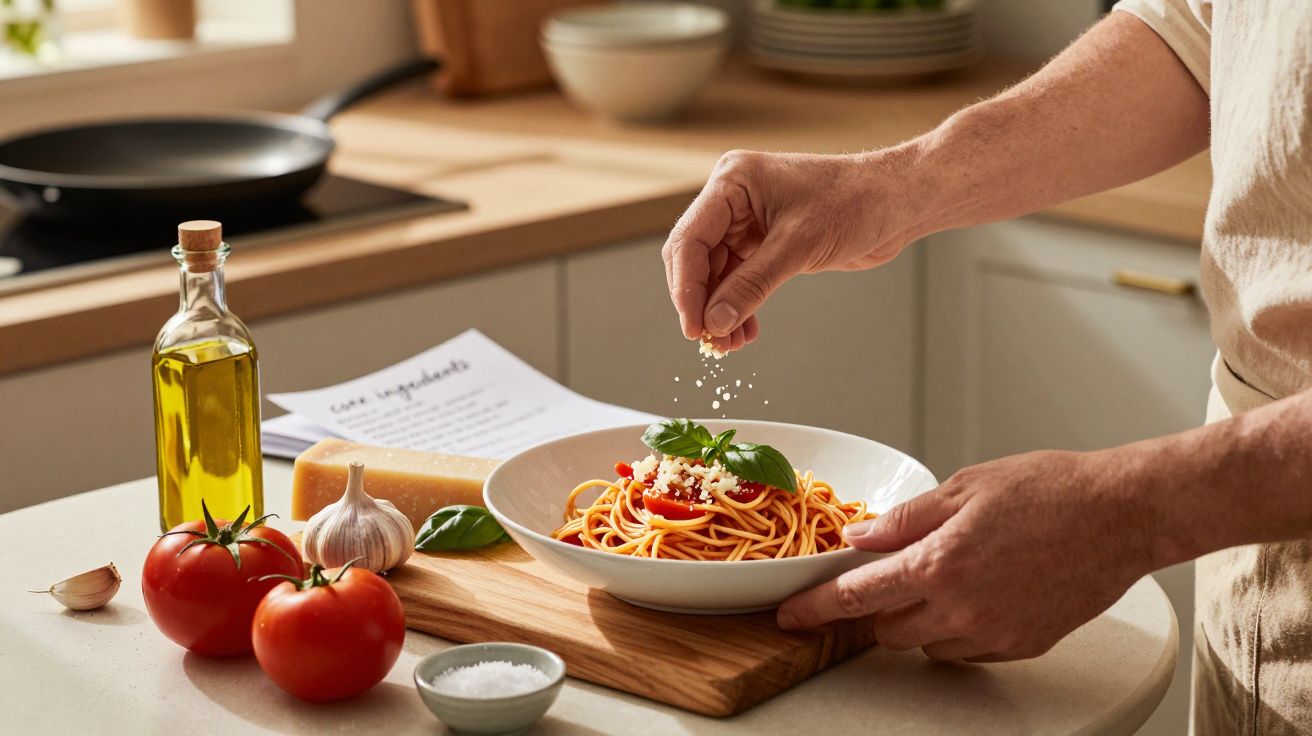
Tuesday night, 7:43 p.m.
You’re parked in front of the fridge with the door wide open, looking at half a lemon, a weary onion, and a piece of chicken you forgot you even bought. Your saved recipes feel like they’re laughing at you. One demands rice vinegar, smoked paprika, and three kinds of soy sauce. Another insists on miso paste, fresh ginger, sesame oil, and a chili you can’t pronounce-much less find at the corner shop.
So you shut the apps, set your phone on the counter, and think, “Maybe I’ll just order something.” The pan stays cold and the chopping board stays clean. Not because you don’t want to cook, but because the steps sound like they were written for someone else’s kitchen-someone with twenty spice jars and a farmer’s market around the corner.
This is exactly where cooking quietly dies for a lot of people.
And where it could just as easily be brought back.
Why simpler recipes work when real life is messy (simple recipes)
The recipes that actually change people’s habits rarely look great on TV. On paper, they can seem almost dull: three, four, maybe five ingredients, a short method, and one pan doing most of the heavy lifting. But those are the meals that get made on a Wednesday when you’re tired, distracted, and done with your day. They work because your brain doesn’t have to wrestle with a shopping list before you even touch a knife.
Think about what you truly repeat-not the showpiece lasagna you made once for friends, but the pasta you throw together weekly. Maybe it’s garlic, olive oil, chili flakes, and spaghetti. Or roast chicken with salt, pepper, lemon, and potatoes. No specialty-store cumin. No “soak overnight” steps you already know you won’t do. These are the dishes that quietly earn a place in your routine because they’re possible on a bad day, not just on a good one.
There’s also a practical psychology behind it. Every extra ingredient is another decision, another point where you can say, “I don’t have that-tomorrow.” Your willpower gets spent before the pan even warms up. Strip a recipe down to its essentials and you’re not only simplifying the grocery run-you’re cutting the mental cost. Less reading, less second-guessing, less “Is this right?” Then you can focus on the few moves that really determine flavor: browning meat properly, salting water well, not rushing onions.
Finding the core of any recipe (and sticking to it)
A useful trick is to take any recipe and ask: “What are the three things that actually matter for flavor here?” Not the garnish, not the optional spice blend, not the pretty topping-the core. For tomato pasta, it might be canned tomatoes, garlic, and olive oil. For a curry, maybe onion, a basic curry powder, and coconut milk. For roasted vegetables, oil, salt, and heat. Everything else is decoration. Cook the stripped-down version a couple of times first; once it feels easy, then add extras when you genuinely want to play.
The biggest trap is trying to cook like a restaurant on a weekday. You watch a chef scatter herbs, oils, crunchy toppings, and think that is the secret. Usually it isn’t. The real difference is the onion softening slowly before anything else goes in, the potato seasoned generously before it hits the oven, the pasta water salted so the noodles don’t taste flat. If the core process is right, a dish can taste surprisingly good even when half the list is missing.
It also helps to remember that “simple” doesn’t mean “lonely.” A few reliable third-party helpers can make weeknight cooking easier without changing the spirit of what you’re doing. A classic like Samin Nosrat’s Salt, Fat, Acid, Heat frames flavor in a way that makes stripped-down cooking feel intentional, not like a compromise. And if you’re learning by watching, creators like Jacques Pépin have spent decades showing how solid technique-basic knife work, proper browning, simple pan sauces-does more than an overstuffed ingredient list ever will.
Another middle-ground option is letting the grocery store do a little work for you. Rotisserie chicken, a bag of frozen vegetables, or a decent jar of tomato sauce from brands like Rao’s (or any reliable local equivalent) can bridge the gap between takeout and “from scratch.” The goal isn’t to prove something-it’s to get food on the plate often enough that cooking stays alive.
Let’s be honest: nobody truly does the “perfect version” every day. Nobody caramelizes onions for 45 minutes after work. Nobody grates fresh nutmeg into béchamel for a Tuesday snack. And that’s fine. What you can do is learn a few anchor moves that run on autopilot:
“Simple recipes don’t make you a lazy cook. They give you enough space to actually become a better one.”
- Choose one main flavor hero (garlic, lemon, soy sauce, chili, herbs).
- Use salt and fat confidently to carry that flavor.
- Repeat the same cooking method until it feels automatic: roast, pan-fry, simmer.
- Buy ingredients you’ll actually finish, not ones you’ll display.
- Accept that 80% good and cooked is better than 100% perfect and never made.
The quiet power of cooking the same simple things
Over time, something shifts when you stick to core-ingredient recipes. You stop rereading every line three times. Your hands learn what medium heat looks like. You taste the sauce and know immediately: “Needs salt,” or “Could use acid.” That kind of confidence doesn’t come from complexity-it comes from repetition. From the same tomato pasta each week, the same roasted veg every Sunday, the same quick chicken and rice you can nearly cook with your eyes closed.
That’s where consistency is built. Not by chasing new recipes, but by relying on familiar ones with small changes. Different herb, same method. Different vegetable, same tray. You create a small personal catalog of dishes that feel like yours, not like you borrowed them from a glossy cookbook. And without noticing, you move from “I can’t cook” to “I can make five things really well.” For most lives, that’s already enormous.
So maybe the real luxury isn’t a pantry full of rare spices. It’s knowing that with four ingredients and one pan, you can feed yourself something warm that tastes like care. You don’t have to wait for a free weekend, a bigger kitchen, or a special occasion. You can start where you are, with what you have, tonight. The recipe is probably shorter than you think.
| Key point | Detail | Value for the reader |
|---|---|---|
| Focus on core ingredients | Identify 3–5 ingredients that drive flavor and structure in a dish | Reduces overwhelm and makes last-minute cooking realistic |
| Repeat simple methods | Use the same basic techniques (roast, sauté, simmer) across recipes | Builds confidence and consistent results without culinary school |
| Lower the mental load | Simpler recipes mean fewer decisions, less shopping stress | Makes cooking feel doable even on tired, busy days |
FAQ:
- Question 1 How many ingredients should a “simple” recipe really have?
- Answer 1 A good range is 3–6 main ingredients, plus basics like salt, oil, and pepper. If the list doesn’t fit comfortably on your phone screen without scrolling, it’s probably not weeknight-simple.
- Question 2 Won’t my food be boring if I cut out half the ingredients?
- Answer 2 Not if you lean on strong flavor builders like garlic, onions, citrus, soy sauce, or chili, and season properly. Most “boring” food is under-salted or overcooked, not under-decorated.
- Question 3 What basics are worth always having at home?
- Answer 3 A neutral oil, olive oil, salt, pepper, garlic, onions, canned tomatoes, rice or pasta, and one or two favorite spices. With those, you can build a surprising number of meals.
- Question 4 How do I adapt complex recipes I love?
- Answer 4 Circle the ingredients that truly change flavor or texture, then drop anything labeled “optional,” most garnishes, and duplicate spices. Test that leaner version once, then add back only what you miss.
- Question 5 Is it “cheating” to use pre-cut veg or jarred sauce?
- Answer 5 No. The goal is to cook more often, not impress a judge. If a jar of decent tomato sauce or a bag of chopped onions gets you to the stove, that’s a win, not a failure.


Comentarios
Aún no hay comentarios. ¡Sé el primero!
Dejar un comentario